.webp)
Written by:
High Mountain Moving Team
Published:
October 7, 2026
Learn how to pack dishes for moving so plates, bowls, and glasses survive the trip. A room-tested method using the right box, wrap, and stacking order.
The best way to pack dishes for moving is to use a dish-pack box with reinforced double walls, wrap every piece individually, stand plates on their edge instead of stacking them flat, and fill every gap so nothing can shift in transit. Dishes don't break from the weight on top of them nearly as often as they break from small movements inside a half-empty box. Stop that movement and you stop most of the breakage.
This isn't complicated, but it is easy to shortcut when you're tired and still have four cabinets to go. Here's a method that holds up over a real move, not just a short drive across town.
Dishes usually break because they're wrapped but not immobilized. Paper or bubble wrap cushions a single impact, but if the dish can still slide, tip, or rattle against its neighbors for hours in a moving truck, that cushioning wears through before the drive is over.
The other common cause is stacking plates flat the way they sit in your cabinet. A flat stack concentrates pressure unevenly and turns one bad bump into a chain reaction through the whole stack. Standing plates on edge, like records in a crate, spreads impact across the rim instead of the center, which is the strongest part of the plate.
Use a dedicated dish-pack box if you can get one. They're built with double or triple-wall cardboard specifically because dishes are dense, unevenly shaped, and unforgiving of weak box walls. A standard medium box will work in a pinch, but it flexes more under weight and offers less protection if it's dropped or jostled.
Avoid oversized boxes for dishes even though it's tempting to fit more in one trip. A large box full of plates gets heavy fast, which makes it more likely to be dropped, and it gives breakable items more room to shift around before everything settles into place.
Cardboard cell dividers (sometimes sold as dish or glass partition kits) split a box into individual compartments. They're most useful for stemware and mugs, which roll and knock into each other more than flat dishes do. If you're packing a full set of glasses, dividers cut breakage risk more than any amount of extra paper.
Each shape fails in a different way, so each one needs a slightly different wrap. Plates need rim protection and vertical loading. Bowls need nested cushioning. Glasses and stemware need wrapping that protects the thinnest, most fragile points first.
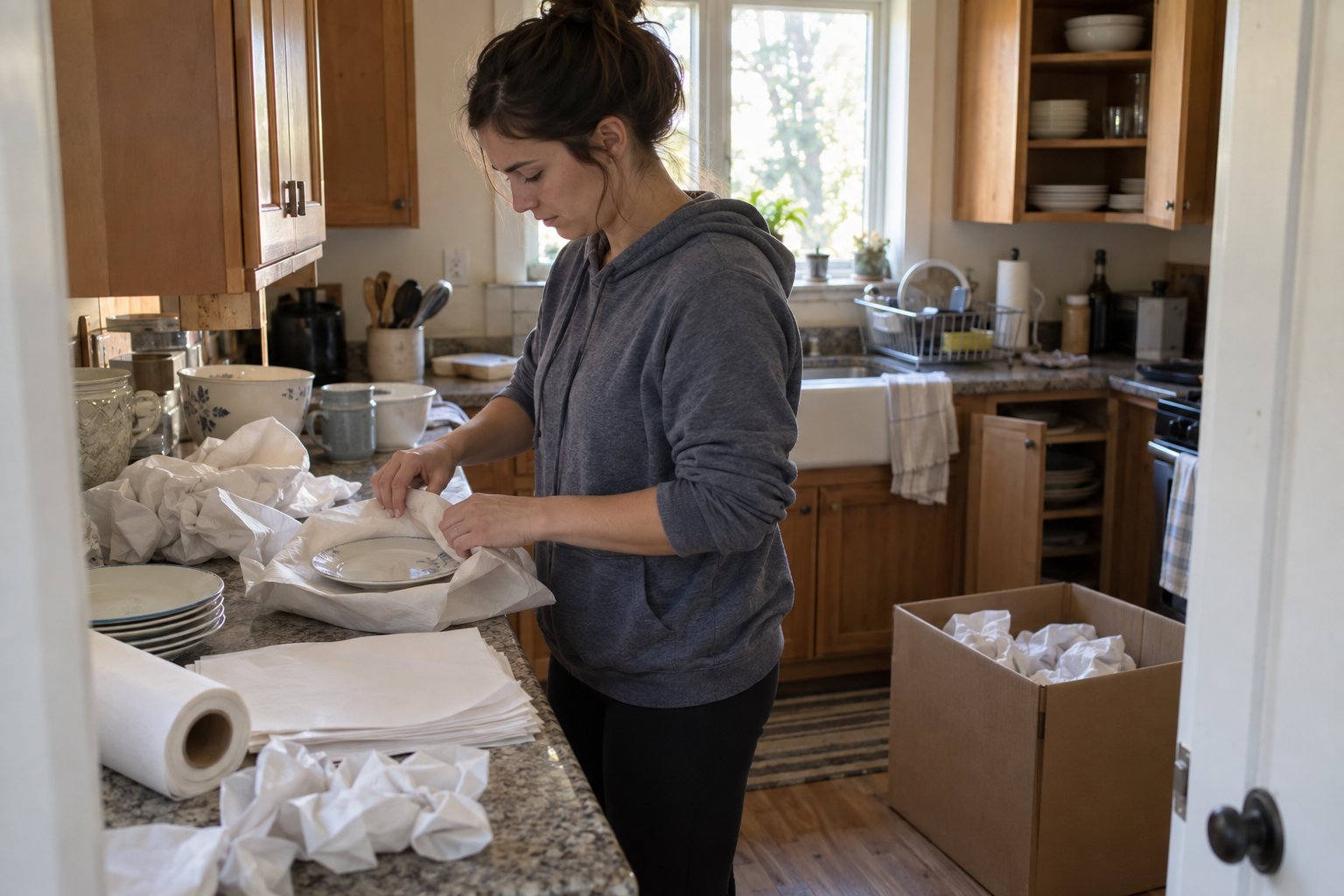
Wrap each plate individually in packing paper, starting corner to corner so the whole surface is covered, then stand the wrapped plates on their edge in the box rather than laying them flat. Group them in small sets of four or five with a folded towel or extra paper between groups so one group can't knock into the next.
Nest two or three wrapped bowls together rather than wrapping and packing each one alone. This mimics how they sit in your cabinet and uses the bowl shape itself as part of the cushioning, as long as there's paper between each one so they aren't touching bare ceramic to ceramic.
Wrap the base and stem of stemware first, since that's the thinnest and most likely point of breakage, then wrap the bowl of the glass. Pack glasses upright, never upside down, and never stack anything heavy on top of a layer that contains glassware.
Line the bottom of the box with two to three inches of crumpled paper before anything goes in, and pack heavier, sturdier items like plates toward the bottom with lighter items like glasses near the top. Fill every gap along the sides and across the top layer with more crumpled paper until nothing moves when you tilt the box.
A good test before you seal the box: pick it up and give it a gentle shake. If you hear or feel anything shifting, open it back up and add more filler. It's a two-minute check that catches the exact problem that causes most dish breakage in transit.
Label the box "FRAGILE" and "THIS SIDE UP" on at least two sides, and keep dish boxes under about 40 to 50 pounds so they're manageable to carry and less likely to be dropped or stacked incorrectly under something heavier.
Packing a few boxes of everyday dishes yourself is manageable if you have the time and the right supplies on hand. Where it gets harder is with large sets, china, or kitchens you need packed quickly without slowing down the rest of your move. In those cases, professional packing takes the fragile-item guesswork off your plate entirely, and it's backed by people who pack kitchens for a living rather than once every few years.
If you'd rather not spend an evening wrapping glassware piece by piece, High Mountain Moving's packing services cover dishware and kitchen items using the same materials and techniques described here, just done faster and with less risk to your back and your dishes.
Unpack dish boxes early, ideally on day one, since fragile items sitting in a stack of boxes for weeks are more likely to get bumped, dropped, or forgotten about until something underneath them gets crushed. Unwrap each piece over a towel or soft surface in case anything was cracked in transit and needs to be set down carefully rather than placed straight into a cabinet.
If you're still working through the rest of your kitchen setup, our guide on what to pack first when moving covers how to sequence the rest of the house so your kitchen doesn't end up buried under boxes you don't need yet.
Dishes are one small piece of a much bigger packing job, and the same shifting-and-cushioning logic applies to almost everything fragile in your home, from framed art to small appliances. If you're organizing packing for an entire household, our moving prep checklist walks through what to tackle in what order so dish boxes don't end up packed in a rush on the last night.
And if the idea of wrapping an entire kitchen by hand sounds like more than you want to take on, get a moving quote from High Mountain Moving and we'll handle the fragile stuff for you.
Wrap every plate individually, not just the top of the stack. Plates in the middle of a stack still shift and knock against each other during a move, and they're just as likely to chip as the ones on top.
Clean towels work well as filler and extra cushioning between groups of dishes, but they don't replace individual wrapping. Newspaper can work in a pinch, but the ink can transfer onto dishes, so plain packing paper is the safer choice for anything you'll eat off of.
Keep dish boxes to a weight you can comfortably carry, usually somewhere around 40 to 50 pounds, rather than a specific dish count. A full set of heavy stoneware will fill a box faster than lighter dinnerware, so weight is the better guide.
A full box helps limit movement, but flat stacking still concentrates pressure on the center of each plate. Standing plates on their edge is safer even in a tightly packed box, since it spreads impact across the stronger rim instead of the center.
Wrap irregular pieces like serving platters or pasta bowls on their own rather than nesting them with standard plates, and pack them in a separate layer with extra paper padding around the edges where the shape doesn't match the box corners.
From Durango to communities across Southwest Colorado, High Mountain Moving is here when you need reliable residential, commercial, or long-distance moving services. Request your free quote today.